Sales loved the feature that was killing us.
At Logility, where I ran technical product management through one of the ugliest turnarounds of my career, the product underneath the interface was the most powerful thing on the market. Deep allocation logic, planning depth, an alerting engine that could watch virtually any datapoint you cared about. None of that mattered. The interface was built for a world of planners who stayed in their seats for a decade. Ours stayed six months to two years, moved on, and took whatever they'd learned with them. Every new planner inherited a tool nobody had time to teach them. Our support lines filled with the same handful of complaints, year after year. And Gartner eventually did what Gartner does: they dropped us out of the Magic Quadrant entirely, the industry ranking that decides which platforms buyers take seriously.
Here's the part that made it hard to fix. Sales and implementation had a feature called tabsets, which let you script custom workflows and data views, and they used it to build demos that matched exactly how a prospect worked. It closed deals. It was also true that almost no customer ever touched it again after go-live, because it was too complicated to maintain once the person who'd configured it left. Two departments, two facts, both real, both backed by data, pointing in opposite directions. Sales said the interface worked. Support tickets and usage logs said it didn't. Nobody had forced the organization to pick one.
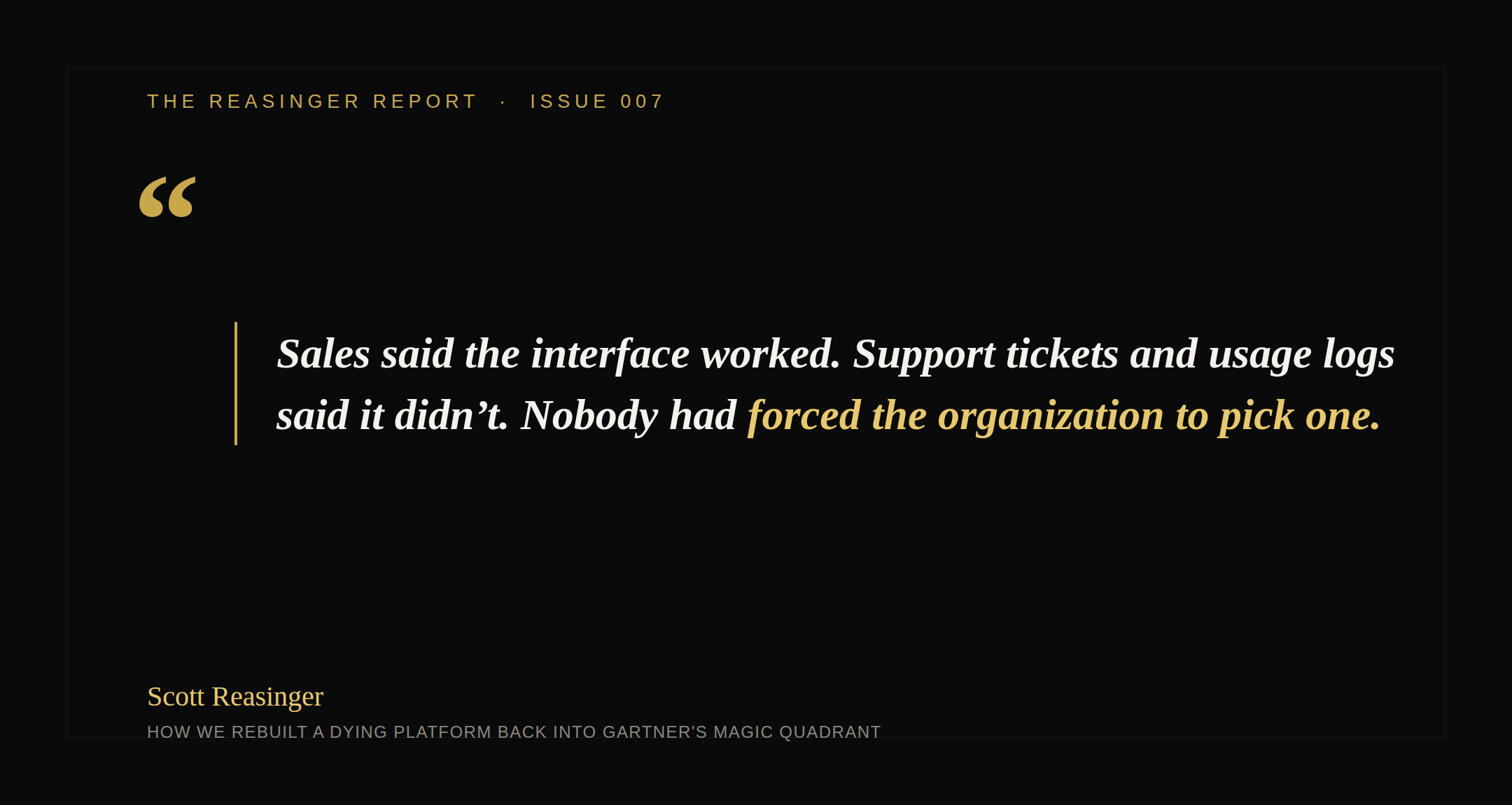
You don't fix a UI problem by redesigning screens. You fix it by finding the one place where two true, conflicting facts are being used to avoid a decision, and you force the org to resolve the contradiction instead of letting each side keep citing its own number.
The second mandate
A second fight broke out around the same time that had nothing to do with the interface - and it's the reason we eventually found tabsets. CloudOps pushed a mandate down from the C-suite as a cost play: get the platform to true multi-tenancy, one shared environment instead of a separate instance per client. Product owned the UI rebuild. CloudOps owned multi-tenancy. Nobody decided whose definition of success would win, so it went political fast - and once it did, the company lost regardless of who technically won, because the mandate had quietly become about protecting a function's turf, not fixing the client experience.
CloudOps solved for CloudOps. They moved every client onto a walled-off multi-tenant environment built for new clients only, betting that lower cost alone would pull existing clients over. It didn't. We ended up rebuilding every feature a hosted client actually used before a single one would move, and the timeline stretched by months.
That stretch is what let us dig in. It forced real conversations with clients about what they actually used - not what the sales deck said they used. Digging in surfaced a second abandoned-but-powerful feature alongside tabsets: an alerting engine with over a thousand prebuilt alerts and no usable way to find the right one. I picked tabsets. Not because it was the easier fight - alerting was arguably worse - but because Gartner wasn't hitting us on alerting. They hit us on the interface itself. Navigation was where the Magic Quadrant fight actually lived.
Winning that fight was never technical. I built an evidence base sales couldn't wave off: usage data, support-ticket patterns, and planner turnover rates showing why the feature they loved was invisible to everyone else. I got my EVP to stand behind it, then took the hits from sales and implementation while we replaced tabsets with something closer to browser bookmarks and folders - saved views down the side of the screen instead of buried inside a configured tabset - something familiar to a new user the moment they sat down. One year later, we were back in the Magic Quadrant. Pipeline was up 50 percent year over year.
Where to start if you're sitting on this right now
One: pull the report on which features actually get used. If something your team is proud of hasn't shown up in six months of usage data, that's not adoption, that's furniture.
Two: ask whoever owns your support queue which two or three complaints keep resurfacing no matter what you ship. That list is your actual roadmap, not the one in the planning doc.
Three: find the one feature or process where two departments both swear they're right. Don't manage that tension, resolve it. That's usually where the real, avoided decision is hiding, and it's costing you more than either side realizes.
The fight was never about tabsets. It was about who gets to decide what "working" means - and most companies let that question sit unanswered for years longer than they can afford.