Almost nobody tells you what happens to Jane. Everyone tells you to find her, the one person who quietly knows how everything actually works, and get it out of her head before she walks out the door. I gave that advice myself a few issues back. It never answered the question that actually matters to the person being documented: if I hand over the thing that makes me valuable, what happens to me?
Renee was that person, years before I had a name for it.
She worked support for a regional electronics and appliance retailer, and a call center of twenty-plus support specialists handed her every transaction that broke. Incomplete data, a malformed record, anything the system choked on - it went to Renee. Not because the org chart said so. Because everyone had learned, one stuck transaction at a time, that she was the only one who could actually fix it. A customer's card that wouldn't charge for a week. A delivery that never showed. Both sat, alone, in her queue every time. She'd built her entire professional identity on being the fixer. Being irreplaceable was her job security, and she knew it.
So when I put a developer next to her, not for one interview but for weeks of actually watching her work, she had every reason to see it as a threat. That's the part the standard knowledge-capture playbook skips. It treats documentation as something done to Jane for the company's benefit. It never has to survive an actual conversation with someone who built her whole reputation on staying impossible to replace. She didn't believe me right away. Why would she.
The developer mapped every kind of manual fix she was making. Most of it got automated outright. What couldn't be automated got turned into tools the rest of the call center could run themselves, so the bottleneck didn't move to a new single point of failure. It dissolved. That mechanism - embedding alongside the expert long enough to extract the actual pattern behind the work - is exactly the kind of process AI can accelerate today, faster than a developer sitting there for weeks. It doesn't make this story old news. It makes the next part more urgent, because there's a lot less lead time to get it right.
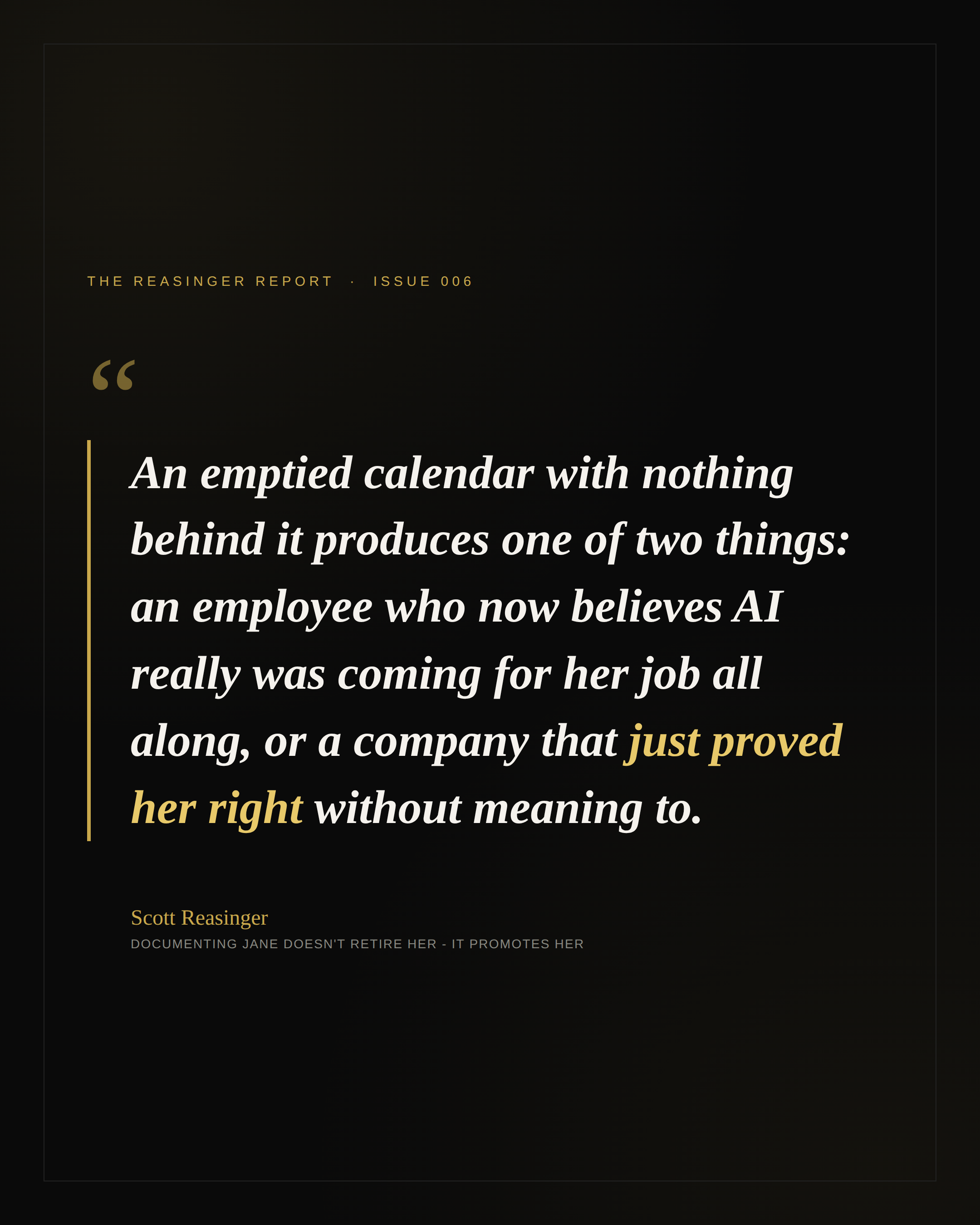
Here's the piece almost every automation pitch leaves out. Automating Renee's job didn't make her more valuable by itself. It emptied her calendar. An emptied calendar with nothing behind it produces one of two things: an employee who now believes AI really was coming for her job all along, or a company that just proved her right without meaning to. Freeing someone up is not the finish line. It's the point where the leader's job actually starts.
So we didn't just automate and hope. We routed her, deliberately, into a store POS project. From there into leading a payment systems upgrade. From there into leading the analysts supporting operations. Three placements, three years, none of them an accident of opportunity. She didn't get flattened into a Cog: same queue, same fixes, promoted to nothing, running out the string on the job everyone had already decided suited her. She turned into a Crank instead: a year into leading the analysts supporting operations, she was the one flagging the next broken process before anyone assigned it to her, not waiting for a ticket. Nobody chained her to fixing one broken thing for the rest of her career, so she stopped waiting to be told which thing to fix next. Each one had to exist before we asked her to give up the job that made her indispensable, not after. Promise someone a future and then go build it later, and you haven't kept a promise. You've made a bet on their patience.
This is the one leadership move most transformation plans never spell out. Finding your cranks and extracting what they know is the easy half, and it's the half every AI vendor pitch already covers. The hard half is deciding exactly where their capacity goes next, before you ever ask anyone to give up the edge that's kept them safe. Not a vague "we'll find you something." You already have the headcount. Build her a role around a real gap in the business, not a placeholder to keep her busy. Skip that step and the next Renee in your building decides the smart move is to stay indispensable. She'd be right to.
I told you what happens when nobody catches it in time. This is what happens when someone does. Renee didn't get documented out of a job. She got documented into three better ones, because somebody decided where she was going before they asked her to leave where she was.
Start this week. Name the person in your org who's the single point of failure for something that would break if she left tomorrow. Before anyone sits down next to her, write down her actual next role, not a placeholder, a real one, and decide who owns making it happen: you, HR, or the sponsoring exec. Only once that answer exists does anyone touch her queue.